I recently saw a reel on Instagram proclaiming “The British are coming!”—a dramatic announcement about the pending arrival of English football (soccer) fans in Boston for a World Cup game.
Two things jumped out. First, Scotland had just played two games in Boston, meaning the British—specifically the tartan variety—had already come and gone. Second, many people in the United States use England and Great Britain (or just Britain) interchangeably. Understandable, yes. Accurate, no.
This raises the bigger question: What exactly is the difference between England, Great Britain, and the United Kingdom? Sometimes the terms overlap. Sometimes they absolutely do not.
Let’s start with geography
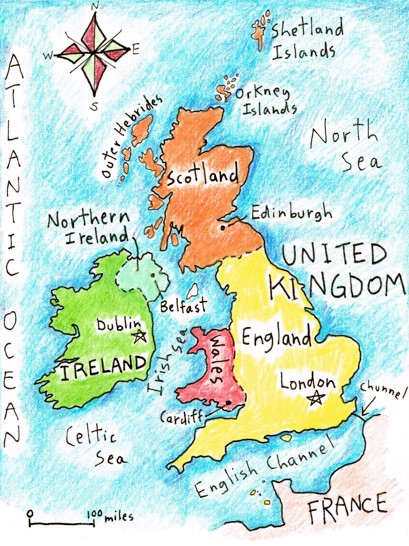
The map above shows the British Isles, a geographic archipelago off the northwestern coast of continental Europe. It includes more than 6,000 islands, notably Great Britain and Ireland, and is divided politically into two sovereign states: the United Kingdom and the Republic of Ireland.
- Great Britain is the largest island, made up of England, Scotland, and Wales.
- Ireland is the second largest and is divided between the Republic of Ireland and Northern Ireland.
- Other major islands include the Isle of Man, the Hebrides, Orkney, and Shetland.
And the politics
- The United Kingdom is the sovereign state made up of England, Scotland, Wales, and Northern Ireland.
- “British Isles” is a traditional geographic term but can be controversial. Because British is associated with the United Kingdom, many people in the Republic of Ireland dislike the term due to a complex historical relationship between the two countries.
Now let’s look at national identity
Everyone born in the United Kingdom gets a British passport. And while everyone is legally British, not everyone feels British.
In Northern Ireland, roughly half the population identifies as Irish instead. Many Scots want an independent Scotland and identify as Scottish, not British. Many others are perfectly happy being both. Wales has its own blend. As a Scottish friend once told me: “I’m British and I’m Scottish, but I’m nae English!”—a distinction delivered with the precision of a surgeon.
England? It’s a bit more complex…English, Welsh, Scottish, and Northern Irish are national identities; British is the shared state identity. But because England doesn’t have its own parliament (and is larger in both population and area), English identity tends to blur more into British identity than Welsh, Scottish, or Northern Irish identity does.
I was born in England to a Welsh mother and an English father and I love being both, but British is the identity that fits. To add to the confusion, I’m also an American citizen.
What we call the place
And then there’s the name: Great Britain or the United Kingdom. These are used interchangeably, but Great Britain doesn’t include Northern Ireland. People usually understand what you mean, though cartographers may quietly judge you.
So the next time someone says, “The British are coming!” feel free to ask which ones.


Leave a comment