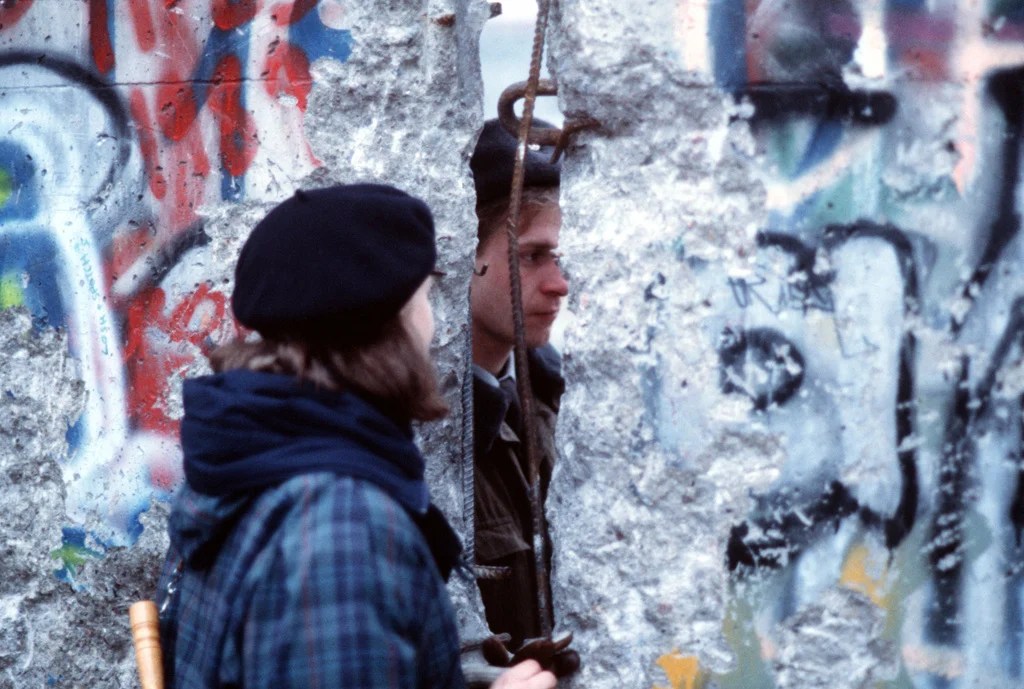
The year was 1989. Revolutions were sweeping across Central and Eastern Europe, dismantling decades-old Communist regimes. And then, on the evening of November 9, the Berlin Wall fell. Almost overnight a closed world opened.
I’d long been fascinated by life behind the Iron Curtain—and the yearning for freedoms we in the West took for granted. Now, as history suddenly shifted, I felt inspired to bring Europeans closer together. I just didn’t know how.
A New Europe, a New Idea
A few months later, I wandered into the Barbican Library in central London, sat down, took out blank sheet of paper, and began to doodle. The idea was still brewing, and I kept coming back to one thought: What if people simply wrote to each other?
Names came and went—then one stuck: Europen. I liked it immediately. I sketched a fountain pen rising from the first “E.” That was it—pen friends! Now I needed a way to find them. A little digging led me to The European, a pan-European English-language newspaper. It had a classifieds section. I wrote a slogan: “Europen: A new idea for a new Europe. Make many new friends today!”
I set up a PO Box, designed a welcome letter, an application form, a pen friend match sheet—and decided on a small fee. In return, I’d send each applicant two pen friends matched by sex, age, country, preferred language(s), and interests.
The Waiting Game
I placed my first ad and waited. And waited. This was exciting! But would it work? After a couple of weeks, a package arrived from The European. Eagerly, I tore it open to find a pile of letters from across Europe requesting pen friends. It had worked. Well, almost. There was one immediate problem: I had no one to match them with.
It was a problem but one I knew I could overcome. I paired a few early applicants and slowly built a database—this was pre-internet, so in reality, a large folder.
The following week brought more applications; the week after, more still. Gradually, I was able to match people and expand the pool. A typical request: a 30-year old woman in Italy seeking male pen friends in France or Great Britain, aged 30-35, writing in English, with interests in literature, biking, and comedy. It felt a little like magic.
Farther Than I Imagined
The Euro was more than a decade away, and I enjoyed receiving payments in European currencies now lost to history—Deutschmarks, Drachma, Francs, Lira, and more. Europen was growing, and around this time I immigrated to the United States.
Within 18 months there were members in 50 countries—many far from the old continent. I even received a wedding invitation from a couple I had matched—a Swiss man and an English woman, or perhaps it was the other way around. Fuzzy memory. My mum would forward the new applications, and I’d handle the matching. Not ideal, but it worked. And then something surprising happened.
A Surge from the East—and the Unexpected Journey it Inspired
One day my mum called. “There’s been a delivery,” she said. “A big one.” Nearly a thousand letters from the former Soviet Union. In a single week. Until then, I’d received maybe four. My small classified ad had been picked up and placed in publications throughout the former Soviet republics—proof of the desire for contact with the West that had long intrigued me.
But I could do little with them. The rouble wasn’t convertible, and few applicants in the West had asked for pen friends from the former Soviet Union. On my next visit home I saw the box—overflowing with letters—and I picked one up. Most were written in Cyrillic, and I admired the beauty of the handwriting. The alphabet was unfamiliar. Almost hypnotic. I decided on the spot to learn Russian. Later that year, I enrolled in evening Russian classes at the University of Minnesota—and studied it for the next two years.
From Pen Friends to Pixels
Then came the internet. New sites let people connect instantly—and for free. Around the same time, Robert Maxwell—then owner of The European—died in mysterious circumstances off the Canary Islands. The paper eventually changed hands. The classified section was now buried in another part of the paper and the responses dropped a lot.
Gradually, Europen came to an end.
Looking Back
I look back with nostalgia on an idea born in a moment now part of history. For a while, though, it felt magical: handwritten letters. Stamps from across the world. Requests for friendship crossing borders that were once sealed.
Europe has moved on since the days of Europen. The European Community became the European Union. Germany reunified. Yugoslavia and Czechoslovakia disappeared. The beautiful old banknotes are now just a memory. And I often wonder how many of the people I matched are still in touch. And how many, unexpectedly, ended in marriage.


Leave a Reply